
Baroreflex Training: Understanding the Baroreflex
Everyone knows stress is bad. Most people know cortisol is the stress hormone. Some people track HRV. Almost nobody knows what actually controls all of it.
It's called the baroreflex and it's one of the most important systems in your body you've never heard of.
Your Body's Internal Regulator
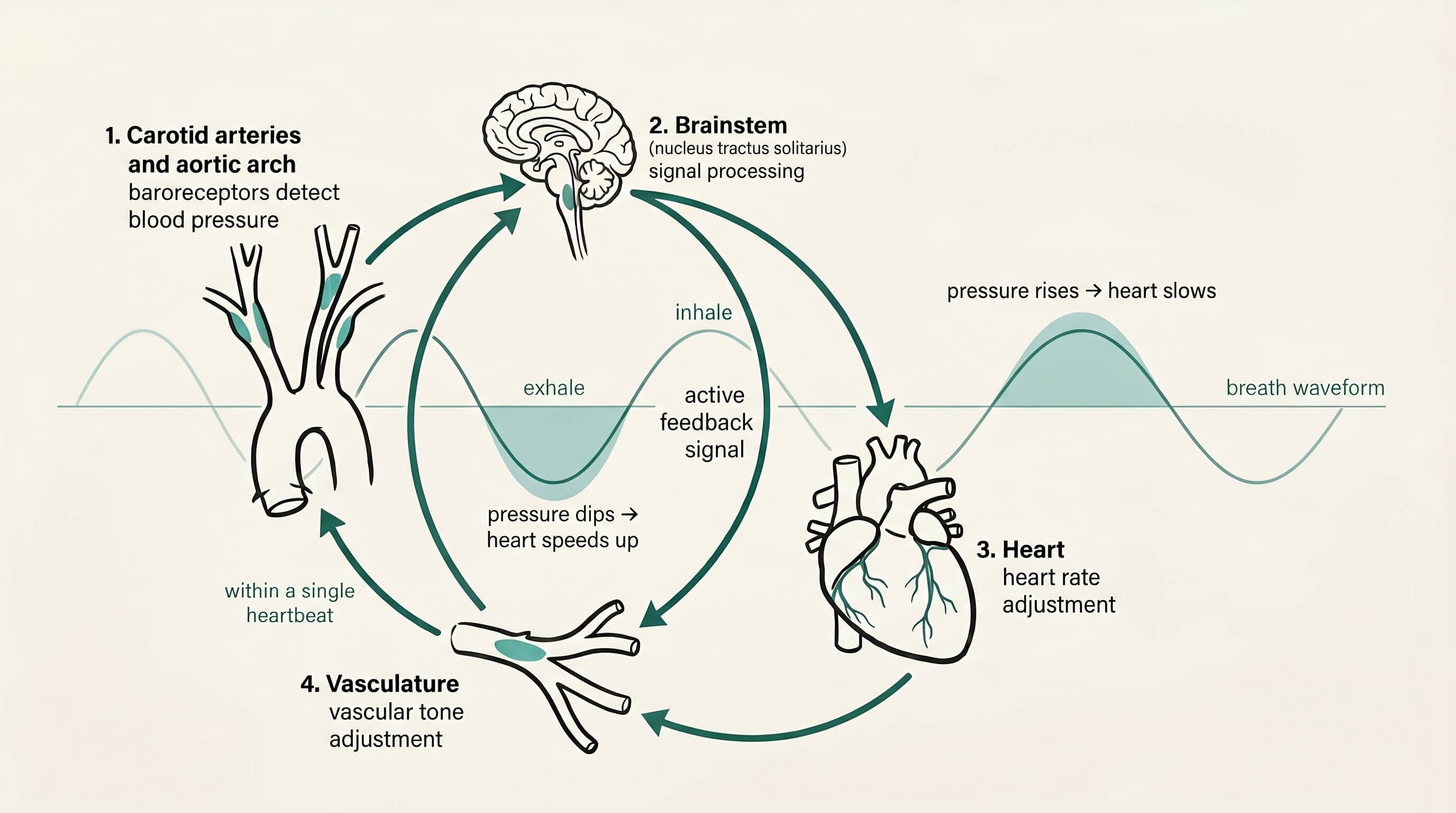
Your baroreflex uses tiny stretch sensors in the neck and heart to constantly manage your blood pressure.1 When pressure rises too high, those sensors signal the brain to hit the brake, which slows the heart and dilates the blood vessels.1 When pressure drops too low, they trigger the gas by speeding up heart rate and tightening the vessels.1
It's running in the background every second of your life, and it's the primary mechanism by which your body shifts between stressed and recovered states.2
Your Whoop, Oura ring, and Apple Watch can see your baroreflex weakening. They track the symptoms, falling HRV, rising resting heart rate, fragmented sleep. None of them can train the underlying system. That's the gap BaroShift fills.
Why Your Baroreflex Needs Training
How powerfully your baroreflex responds is called baroreflex sensitivity (BRS), the body's stress recovery horsepower. High BRS means you shift quickly from stressed to recovered. Low BRS means stress lingers, blood pressure stays elevated, and the body takes longer to return to baseline after any kind of challenge.
The baroreflex weakens with chronic stress and with age. Research links a reduced BRS to higher blood pressure, slower cognitive performance, poorer sleep, and greater cardiovascular risk.4 Passive trackers can see this happening. They just can't do anything about it. Neither can the standard mental and behavioral toolkit (meditation, mindfulness, breathwork apps, sleep hygiene). These help with the subjective experience of stress but do not directly train the autonomic regulator producing it.
BaroCapacity captures that engagement directly. The same optical sensor described above reads how closely your heart rhythm tracks the breathing pattern moment to moment, whether that alignment holds steady across the whole session rather than spiking once and fading, and how much heart rate rises and falls with each breath. Those three signals combine into the 0–100 BaroCapacity score. It's baroreflex engagement, read in real time, every time you train.
Why This Requires Hardware
You cannot train an individualized physiological loop without measuring the loop. That's why BaroShift is a wearable, not an app.
Your baroreflex interval is unique and shifts with physiology over time: with stress load, sleep quality, and cardiovascular state on any given day. A generic breathing app has no way to know this. It assigns everyone the same tempo and hopes for the best.
BaroShift's sensor measures your cardiovascular response in real time. The 8-minute calibration session doesn't just guess at the interval; it captures the actual timing of the baroreflex loop and locks the protocol to it. Every subsequent session is calibrated to the physiology you showed up with that day.
This is the difference between a breathing app and autonomic training. A breathing app delivers a tempo. BaroShift delivers a measured intervention to a measured system.
Why Baroreflex Training Requires Personalization
Training your baroreflex requires hitting it at exactly the right rhythm. Here's why. Every time you inhale, the heart naturally speeds up, and every time you exhale, it slows down.5 Breathe at your unique pace and breath and baroreflex fall into perfect sync, creating large, healthy swings in heart rate and blood pressure.6
Breathe at the wrong pace, and nothing happens.
Think of pushing a child on a swing. Push at a random time and it wobbles. Push at exactly the right moment and it glides effortlessly higher.6 Generic apps assign everyone the same breathing rate, they're just guessing at your timing. If you're out of sync, you never get the swing moving.
BaroShift finds your exact interval. In a single 8-minute calibration session, the sensors capture cardiovascular data and pinpoint the baroreflex interval, typically somewhere between 4.5 and 7.5 breaths per minute.3 Every subsequent session guides at that exact pace, keeping breath and baroreflex in sync.
What Training Does to Your Body
Breathing at your unique interval feels calm. What's happening underneath is a physical workout for the baroreflex. Resonance training produces measurable, cumulative changes to your physiology:
- Baroreflex sensitivity increases: your body shifts out of stress faster and recovers more completely. You won't feel the reflex itself. What you'll notice is feeling back to normal sooner after a difficult meeting, being less reactive to things that used to spike your stress response, and a growing sense that challenges feel more manageable.4,7
- HRV climbs: your autonomic nervous system (the part that runs in the background, without your conscious input) becomes more flexible and resilient. Rising HRV over weeks is objective evidence that the training is working, your nervous system is becoming better at shifting between activation and recovery on demand.7,8
- Blood pressure decreases: as your baroreflex becomes more sensitive, it regulates blood pressure more effectively.4
- Stress reactivity drops: challenges that used to spike your system feel less intense over time.7
- Cognitive performance improves: sharper focus, clearer decision-making, less brain fog. The mental sluggishness that builds up under chronic stress begins to lift.8 Read: "Why 8 Hours of Sleep Isn't Translating Into Clarity" →
- Perceived stress decreases: your nervous system is spending less time in sympathetic overdrive and more time in recovery.8
- Sleep quality improves: as your nervous system spends more time in parasympathetic recovery, falling asleep after a stressful day becomes easier.8,9 Read: "Why You're Waking Up at 4:30 AM After 50" →
The Research Behind These Changes
Research curated by Dr. Michael Gilbert, PhD Organic Chemistry · 20 years drug discovery · Founder, BaroShift
Resonance breathing restored BRS in hypertensive patients to levels seen in healthy people.
Joseph et al., Hypertension, 20054
After four weeks of daily resonance training, total HRV power increased significantly and autonomic balance shifted measurably from sympathetic to parasympathetic dominance.
Chaitanya et al., Cureus, 20228
Systolic blood pressure fell by nearly 9 mmHg and diastolic by nearly 5 mmHg, an effect entirely absent at faster breathing rates.
Joseph et al., Hypertension, 20054
After just 15 minutes of resonance breathing, people showed significantly lower blood pressure reactivity during a cognitive stressor and recovered faster afterward. This was seen only in those breathing at their exact resonance frequency.
Steffen et al., Frontiers in Public Health, 20177
Attention, processing speed, and executive function all improved significantly on objective tests with no change in controls.
Chaitanya et al., Cureus, 20228
Stress scores fell significantly in the training group with no change in controls.
Chaitanya et al., Cureus, 20228
"As a practitioner who regularly works with the breath, I highly value the ability to see metrics on what my practice is doing physiologically. The personalized feedback BaroShift provides is completely unique and its absolute best feature."
— Evelyn Neaman, Director at Tikkun Center & Member since January 2026
This Is Autonomic Training
Whoop, Oura, and Apple Watch tell you your baroreflex is weakening. BaroShift trains it back.
The hardware measures your baroreflex. The protocol trains it. The result is a measurable upgrade to how your nervous system handles stress, not a feeling, a physiological adaptation that compounds over 100 days.
Shop BundlesBaroreflex Training: Every Question Answered
What is the baroreflex?
Your body has a built-in mechanism that controls whether you're in stressed or recovered mode. It's called the baroreflex. Tiny pressure sensors in the neck and heart constantly monitor your blood pressure and signal the brain to speed up or slow down the heart accordingly.
It runs every second of your life without any conscious input, and it's the primary switch between sympathetic (fight-or-flight) and parasympathetic (rest and recover) states. Most people have never heard of it. That's the problem.
Baroreflex vs cortisol: what's actually controlling your stress response?
Cortisol is a downstream signal. By the time it spikes, your brain has already decided you're under threat and locked your body into fight-or-flight. Cortisol is the aftermath, not the cause.
The baroreflex is what triggers the shift upstream. When stress hits, the brain temporarily suppresses this internal regulator so heart rate and blood pressure can rise to meet the threat. Training your baroreflex gives you a way back. Syncing breath to your personal baroreflex interval acts as a manual override, calming the nervous system in the moment. But the deeper purpose is structural. Consistent training acts like physical therapy for the autonomic nervous system, permanently increasing baroreflex sensitivity. Over time, the body learns to buffer stress and shift back into recovery on its own, even when you're not actively doing the breathing.
Tracking cortisol only tells you that you were stressed. Training your baroreflex fundamentally upgrades how your body handles stress in the first place.
Baroreflex vs vagus nerve: what's the difference?
The vagus nerve is the highway. The baroreflex is the traffic system that runs on it. The vagus nerve carries signals between the brain and the organs, including the heart. The baroreflex uses those pathways to regulate blood pressure and autonomic state in real time. Training your baroreflex strengthens vagal tone, but they're not the same thing. The vagus nerve is the infrastructure. Baroreflex sensitivity is how well you use it.
What does aging do to your baroreflex?
It weakens it significantly. Research by Monahan and colleagues found that baroreflex sensitivity declines by roughly a third in sedentary middle-aged men compared to young adults, and by nearly 60% in older sedentary men. The consequence: slower recovery from stress, less cardiovascular adaptability, and higher blood pressure variability.
The critical finding, though, is that this decline is not inevitable. In men who exercised regularly, the magnitude of decline was only half as great. The baroreflex responds to training at any age.
Why is my heart rate variability (HRV) low, and what do I actually do about it?
Low HRV means your autonomic nervous system is operating rigidly. It can't adapt smoothly to stress. Most wearables will tell you this. None of them tell you what to do about it.
The answer lies in baroreflex sensitivity (BRS). A stronger baroreflex means faster, more complete shifts between stressed and recovered states, which shows up directly as higher HRV. You don't improve HRV by tracking it. You improve it by training the mechanism underneath it.
Why don't generic breathing apps work?
Because everyone's baroreflex interval is different. There's a specific breath rate, unique to your physiology, at which breath and baroreflex fall into perfect sync, producing large healthy swings in heart rate. Hit that rate and the nervous system responds immediately.
Breathe at someone else's rate and nothing happens. Generic apps assign everyone the same pace. If it doesn't match your interval, you're just breathing slowly, not training anything.
Is baroreflex training the same as relaxation?
No. Breathing at your unique baroreflex interval feels calm but what's happening underneath is a physical workout for the autonomic nervous system. You're repeatedly driving large oscillations in heart rate and blood pressure, forcing the baroreflex to respond and adapt.
Over time, that repeated stimulus produces structural changes in how your nervous system is wired. It's closer to strength training than a relaxation practice.
What happens during a single session?
Each session immediately shifts you out of fight-or-flight by engaging the vagal brake, dropping heart rate and blood pressure on demand. The large cardiovascular oscillations produced during training send a wave of regulating signals up to your brainstem, increasing prefrontal cortex activation and reducing amygdala reactivity.
The result in the session itself: sharper focus, lower sympathetic arousal, and an easier transition into deep sleep if training before bed.
What changes with consistent training over weeks?
Two things happen. First, your baroreflex sensitivity increases, meaning your body buffers stress faster and recovers more completely after each stressor.
Second, your HRV climbs. Heart rate variability rises as the autonomic nervous system becomes more flexible, able to adapt to stress smoothly rather than reacting rigidly. These aren't subjective improvements. They're measurable changes in how your physiology operates.
Does it affect the brain, not just the heart?
Yes, and this is the part most people don't expect. Your vagus nerve is 80% upward-travelling fibres. The heart sends far more neural traffic to the brain than the other way around.
When your baroreflex is trained and producing strong cardiovascular oscillations, those signals travel up to your brainstem and directly influence prefrontal cortex activation and amygdala reactivity. Better baroreflex function means a calmer, sharper brain, not just a healthier heart.
How does BaroShift help with stress?
Most stress tools tell you to relax. BaroShift trains the mechanism that actually controls whether your body is stressed or recovered in the first place.
That mechanism is the baroreflex, the primary switch between sympathetic (fight-or-flight) and parasympathetic (rest and recover) states. A stronger baroreflex means your body shifts out of stress faster, recovers more completely, and is less reactive to the next stressor.
BaroShift finds your personal baroreflex interval, the precise breath rate at which your heart and nervous system synchronise, and guides your daily training at that exact timing. The result over time is a measurable increase in how quickly and completely your body recovers from stress.
That's not stress management. That's a structural upgrade to your stress response.
Cardiovascular Resilience Assessment
Want to see where your regulator sits?
The Cardiovascular Resilience Assessment uses 5 questions to map your relationship with the system behind your RHR and HRV. 3 minutes. Free.
Take the assessment →Scientific References
- Kaufmann H, Norcliffe-Kaufmann L, Palma JA. Baroreflex dysfunction. New England Journal of Medicine. 2020;382(2):163–178.
- Suarez-Roca H, Mamoun N, Sigurdson MI, Maixner W. Baroreceptor modulation of the cardiovascular system, pain, consciousness, and cognition. Comprehensive Physiology. 2021;11(2):1373–1423.
- Shaffer F, Meehan ZM. A practical guide to resonance frequency assessment for heart rate variability biofeedback. Frontiers in Neuroscience. 2020;14:570400.
- Joseph CN, et al. Slow breathing improves arterial baroreflex sensitivity and decreases blood pressure in essential hypertension. Hypertension. 2005;46:714–718.
- Yasuma F, Hayano JI. Respiratory sinus arrhythmia: why does the heartbeat synchronize with respiratory rhythm? Chest. 2004;125(2):683–690.
- Lehrer PM, Gevirtz R. Heart rate variability biofeedback: how and why does it work? Frontiers in Psychology. 2014;5:756.
- Steffen PR, et al. The impact of resonance frequency breathing on measures of heart rate variability, blood pressure, and mood. Frontiers in Public Health. 2017;5:222.
- Chaitanya S, et al. Effect of resonance breathing on heart rate variability and cognitive functions in young adults: a randomised controlled study. Cureus. 2022;14(2):e22187.
- Sakakibara M, et al. Efficacy of paced breathing at the low-frequency peak on heart rate variability and baroreflex sensitivity. Applied Psychophysiology and Biofeedback. 2020;45:31–37.