

The cardiovascular layer underneath your numbers.
Take the 3-minute Cardiovascular Resilience Assessment. We'll show you the autonomic regulator behind your resting heart rate and HRV, and what actually moves it.
What are you most interested in improving?
No login. No spam. From a drug-discovery chemist, not a wellness app.
The autonomic loop behind your numbers
One underlying system drives resting heart rate and HRV. It's called the baroreflex.
The baroreflex stabilizes your blood pressure moment to moment, breath by breath.
Pressure sensors in your carotid arteries and aortic arch detect changes within a single heartbeat. The brainstem responds in real time, adjusting heart rate and vascular tone.
Every exhale, blood pressure briefly dips. The baroreflex catches the dip by speeding the heart up.
Every inhale, pressure rises. The baroreflex slows the heart back down.
That cyclical speed-and-slow across the breath is one of the main physiological sources of HRV itself. And the efficiency of that loop is what lets your heart rest at a lower rate.
Both metrics. Same engine.
The published method.
The research on training the baroreflex goes back decades.
The mechanism with the strongest published evidence: slow-cadence breathing at an individual's resonance frequency.
The pacing produces large oscillations in blood pressure across the breath cycle. Those oscillations trigger the baroreflex to strengthen.
Daily repetition makes the loop faster and more sensitive. Resting heart rate tracks downward. HRV becomes more dynamic.
The catch is personalization.
The full baroreflex loop response varies from about four to eight seconds between individuals. That's a twofold range. A breathing cadence calibrated to population averages misses the resonance frequency for most users.
This is why generic breathing apps produce inconsistent results. Box breathing, six-breaths-per-minute, fixed-cadence protocols. These are population averages, not individual training protocols. They engage the loop for some users and miss the target for others.
Personalization is the whole game.
What BaroShift does about it
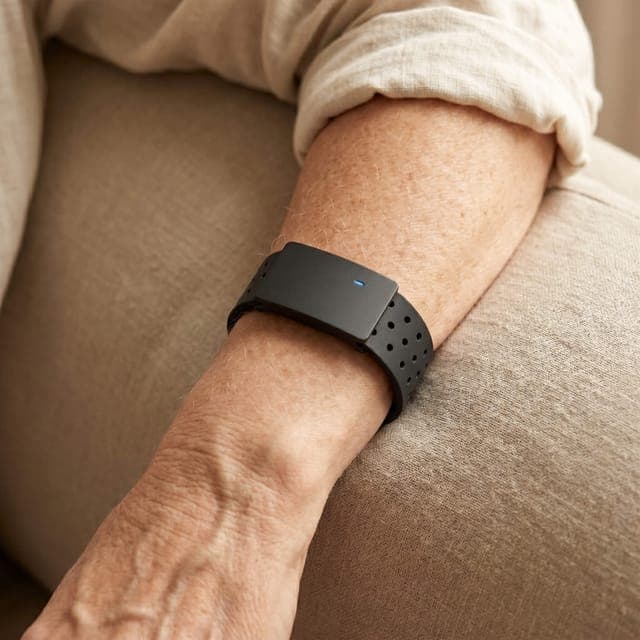
BaroShift is a forearm wearable that measures your individual baroreflex signature.
It then paces an 8-minute daily session at the cadence that engages your specific loop.
The wearable reads your live cardiovascular response and adjusts the pacing in real time as your autonomic state shifts.
Closed-loop training. Not open-loop guessing.
The 100-Day Foundation Pass includes hardware plus 100 days of software access.$99.99.
The 100-day timeframe is what the autonomic adaptation research suggests is needed for meaningful baseline shift.
Resting heart rates typically settle by week four or five.
HRV becomes more dynamic across the breath cycle in the exact same window.
The Day-60 biological report formally confirms the adaptation.
Hardware ships from Vancouver. Software access starts on first calibration.

BaroShift was built by Dr. Michael Gilbert.
Two decades in pharmaceutical research on atrial fibrillation, hypertension, and Alzheimer's.
Then a severe back injury left him with a dysregulated autonomic system that conventional medicine could not fix.
The conventional cardiovascular protocol helped at the margins but didn't restore the autonomic regulator that had drifted.
BaroShift came out of building the precision tool he needed for himself.